Khimar Wholesale: The Layered Covering Buyers Underestimate
A khimar looks simple and is not. Its curved hem, its layers and its length tiers are where quality and cost are decided — and where most orders go wrong.
What a khimar is, and what it is not
A khimar is a head and shoulder covering that falls like a cape. It is not a hijab scarf and it is not a jilbab: it covers the head, neck and shoulders down to a variable length, and it is worn over clothing rather than instead of it.
That distinction matters for ordering, because a khimar is bought as part of an outfit rather than as an accessory. The customer chooses it against her abaya or dress, which means colour coordination and length coordination matter as much as the piece itself.
- Covers head, neck and shoulders in one piece
- Falls to a chosen length — shorter for daily wear, longer for fuller coverage
- Usually fastened with ties, a headband or a simple opening
- Worn over clothing, coordinated with the rest of the outfit
Shape and cut: where the cost is decided
The shape of a khimar determines how much fabric it uses, how it drapes and how easy it is to finish. A semicircle gives the fullest, most even drape and uses the most fabric. A rectangular cut is more economical and reads more angular. Triangular cuts sit in between.
Buyers often choose shape last. Choose it first, because the pattern, the fabric consumption and the hem length all follow from it.
| Shape | Drape | Fabric use | Hem behaviour |
|---|---|---|---|
| Semicircle | Fullest and most even around the shoulders | Highest | Curved hem, longest at the centre back |
| Triangular | Soft, with a defined point at the back | Moderate | Angled hem, requires careful corner finishing |
| Rectangular | Straight and simple | Lowest | Straight hem, easiest to finish consistently |
| Layered variation | Depends on the outer layer shape | High — two or three garments of fabric in one product | Multiple hems that must stay aligned |
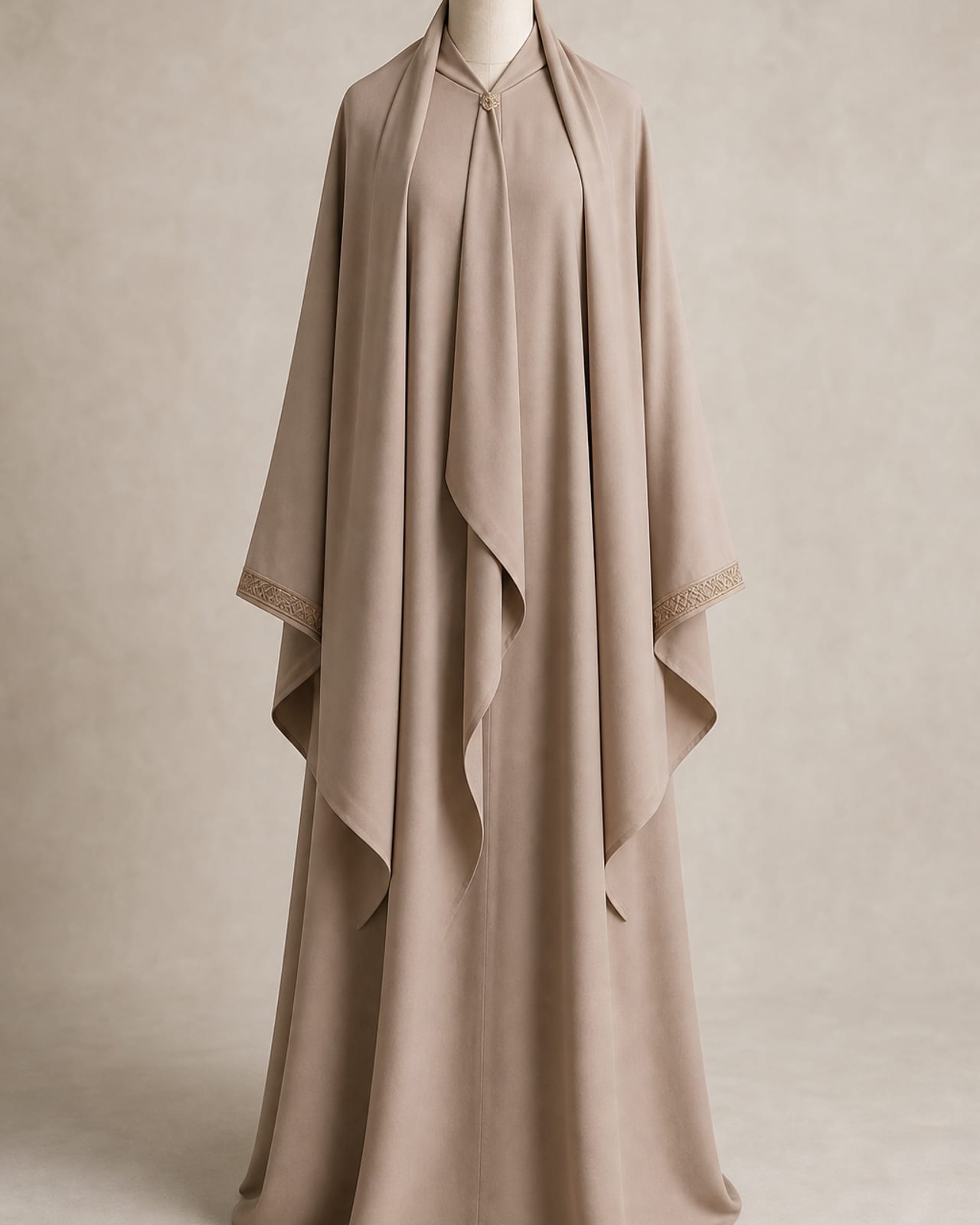
Layers: the feature that defines a premium khimar
On a multi-layer khimar, the difference between the layer lengths is the design. Approve it in writing, in numbers, on the sample.
Multi-layer khimars use two or three panels of fabric at different lengths to create depth and movement. They photograph beautifully and they sell at a higher price point — and they multiply the production work.
Every added layer means another hem to finish, another length to control and another opportunity for misalignment. If you order a three-layer style, expect the sample to take longer and the quality checks to be more detailed.
- Single layer — the everyday product, simplest to produce
- Two-layer — the volume premium style, with a shorter upper layer
- Three-layer — the fashion statement, highest cost and highest risk
- Layer length difference — the proportion that makes the design work
- Layer alignment — the check that decides whether the style reads as designed
Fabric: chosen for a curved hem, not for a garment
A khimar is mostly a large curved or angled hem, so the fabric has to drape well and finish cleanly on a curve. That rules out stiff fabrics and favours materials with movement.
Light chiffon gives the most movement and shows the layers best. Crepe and nida-style wovens hold a defined line and are easier to finish. Jersey drapes softly and needs no ironing, which suits daily wear but shows the layer effect less.
- Chiffon and light wovens — movement, layering and a soft fall
- Crepe — structure on the shoulder and a crisper hem line
- Nida-style fabrics — matt, opaque and easy to maintain
- Jersey and knits — comfort and easy care, with less visible layering
- Opacity — checked as a full garment, since a khimar covers the head and shoulders
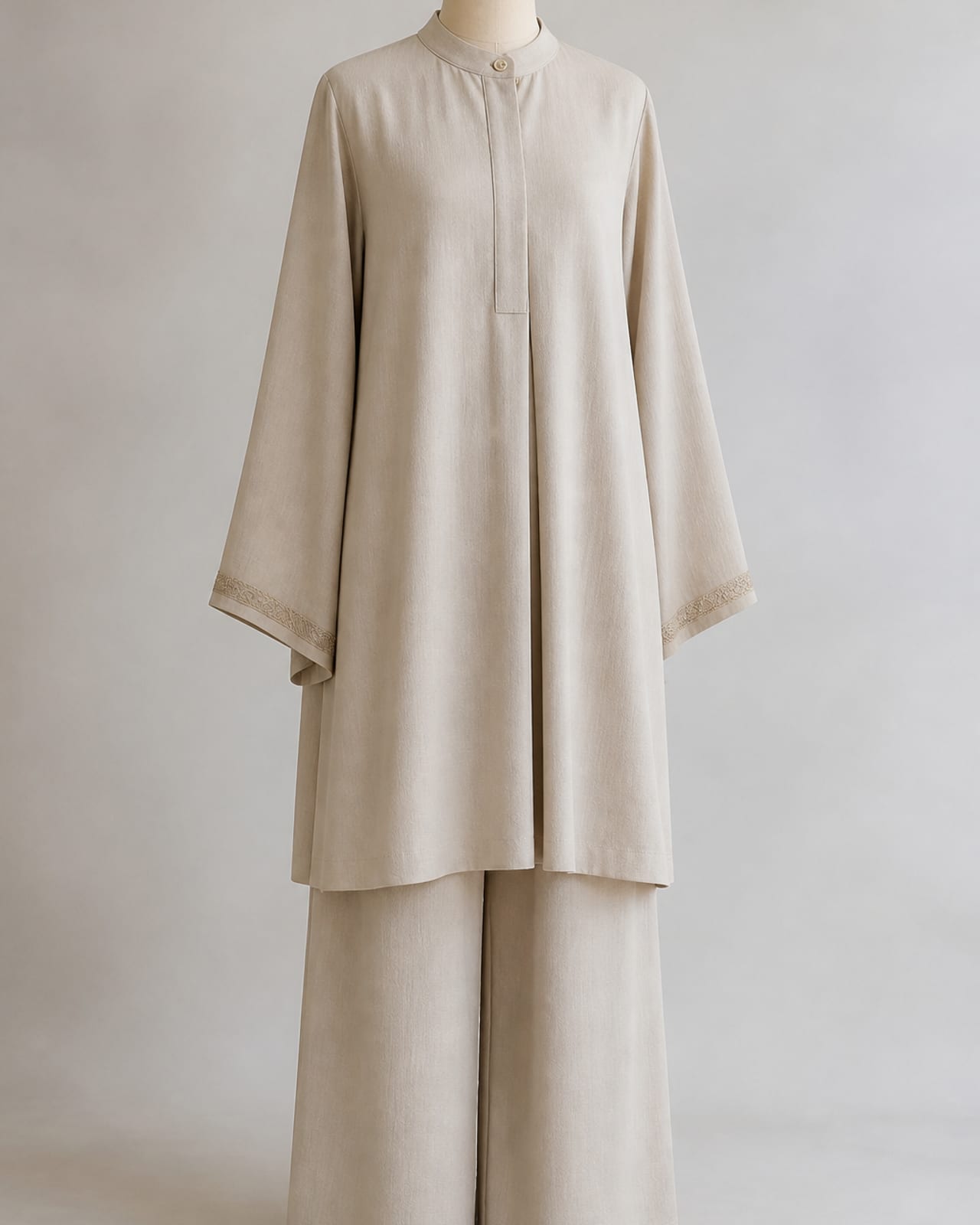
Hem finishing on a curve
Finishing a long curved hem evenly is the hardest part of producing a khimar. If the stitch tension is wrong the hem waves; if the fold is uneven the hem twists; if the fabric is light the hem can stretch out of shape during sewing.
This is the single quality variable to agree in writing. Ask what edge treatment will be used, and inspect it on a sample hung up rather than laid flat, because that is how the customer sees it.
- Edge treatment specified in writing, not left to the production floor
- Evenness checked around the whole curve, not on one section
- No waviness when the garment is hung
- No twisting at the corners or the points of a triangular cut
- Hem stability after washing, tested on a sample
Length tiers and how customers choose
Khimar length is a personal decision that varies by market and by what the customer wears underneath. Shorter lengths suit daily wear over dresses and abayas; longer lengths suit customers who want fuller coverage in one garment.
Rather than guessing, offer two or three defined lengths and let the customer decide. Fewer length options also means simpler cutting and packing, which keeps the range profitable.
- Short length — daily wear, coordinated with a dress or an abaya
- Mid length — the volume seller in most markets
- Long length — fuller coverage, often sold as a premium style
- Length measured from a fixed point, so the specification is repeatable
- Front and back length relationship — a detail that changes the look significantly
Selling khimar as part of an outfit
The customer buying a khimar is usually buying a look, which makes it a natural companion to the abaya range and to modest sets. Coordinating colours across both is the fastest way to raise average order value.
If you sell online, a coordinated khimar and abaya photograph as one product and can be listed as a set. If you sell in a shop, hang them together — the customer who came in for one garment often leaves with two.
- Colour coordination across khimar and abaya
- Coordinated sets listed as one retail unit
- Undercap or headband supplied with the garment, where the design needs one
- Matching prayer wear for a complete collection
What to specify in a khimar enquiry
Khimar quotes are driven by shape, layers, length and hem finishing. These points let us price the garment you actually intend to sell.
- Shape — semicircle, triangular, rectangular or layered
- Number of layers and the length of each
- Fabric and the drape you are looking for
- Length tier and how it is measured
- Fastening method — ties, headband, opening or closed
- Colour range and the physical standard for each shade
- Packing and labelling level
Quality checks for a khimar order
Because a khimar is a large piece of fabric finished on a curve, defects are visible from a distance. That makes inspection straightforward — provided the checks are done with the garment hung, not folded.
- Hem evenness and twist — checked hung, around the full curve
- Layer alignment — each layer at the approved length and proportion
- Symmetry — left and right sides matching on an asymmetric cut
- Coverage — checked on a person, in daylight, over the shoulders and back
- Fastening strength — ties, bands or openings pull-tested
- Shade consistency — critical across pieces sold as a set
Frequently asked questions
A khimar is a head and shoulder covering worn over clothing, usually ending between the waist and the knee. A jilbab is a complete covering garment that extends over the body with the head covering integrated. The khimar sits above the outfit; the jilbab is the outfit.
Single-layer is the everyday product and the safer first order. Multi-layer styles sell at a higher price point and photograph better, but each layer adds another hem to finish and another length to control, so they take longer and need stricter checks.
Fabrics with movement and a stable edge: light chiffon for drape, crepe or nida-style wovens for a defined line. Very stiff fabrics sit awkwardly on the curve and very light fabrics can stretch out of shape during finishing.
Two or three defined lengths is usually enough, because length preference varies more than size within a market. A shorter length for daily wear, a mid length as the volume seller and a longer premium option covers most demand without complicating cutting and packing.
Contact us for current MOQ. It depends on the shape, the number of layers, the fabric, how many lengths you want, the colour count and the packing level. A three-layer style carries considerably more production work than a single-layer one.
No. Price depends on shape, layers, fabric, length options and packing, so it is quoted per order. Send the specification and destination and the quote will apply to your order rather than being a general list.
Planning your next modest fashion collection?
Tell us these seven things and we can come back with a workable sourcing plan instead of a price list.