Wholesale Modest Dresses and Muslim Dresses
A modest dress is a fitted garment, so this page treats length, lining and measurement as buying decisions rather than afterthoughts — and shows how to specify them before sampling.
Who buys wholesale modest dresses, and for which market
Dress buyers usually arrive from one of two directions. Some are already selling abayas and want a garment the customer can wear alone, without layering. Others sell modest fashion generally and treat the dress as the core product, with hijab and outerwear around it. Both are served here, but they need different ranges: the first needs a dress that reads as an abaya alternative, the second needs width.
Market also changes the brief. Occasion-led markets buy decoration, drape and a narrower colour palette. Everyday markets buy opacity, easy care and a size run that covers a realistic range of bodies. Print-led markets buy artwork and colour above all, and evaluate the same construction very differently.
- Boutiques adding a dress rail beside abayas and sets
- Online and social commerce sellers who need styles that photograph well on a hanger
- Modest fashion brands building a private label dress line
- Wholesalers and distributors who need several price positions in one shipment
- Occasion and Eid buyers working to a fixed selling window
- Sellers serving warm climates where light, opaque fabric sells all year
How the dress range is grouped
Dresses are grouped by the occasion they sell into and by how much coverage they provide, because that is what decides fabric, lining and price position. The groups listed further down this page describe the styles we can supply and develop; a single order can draw from several groups.
- Everyday dresses — long, unlined or lightly lined, made for repeat purchase
- Occasion dresses — embroidery, beading, satin and layering
- Lined and layered dresses — coverage first, styling second
- Comfort and at-home dresses — relaxed cuts in easy-care fabric
- Printed dresses — artwork carries the design
- Custom dresses — your pattern, measurements and label
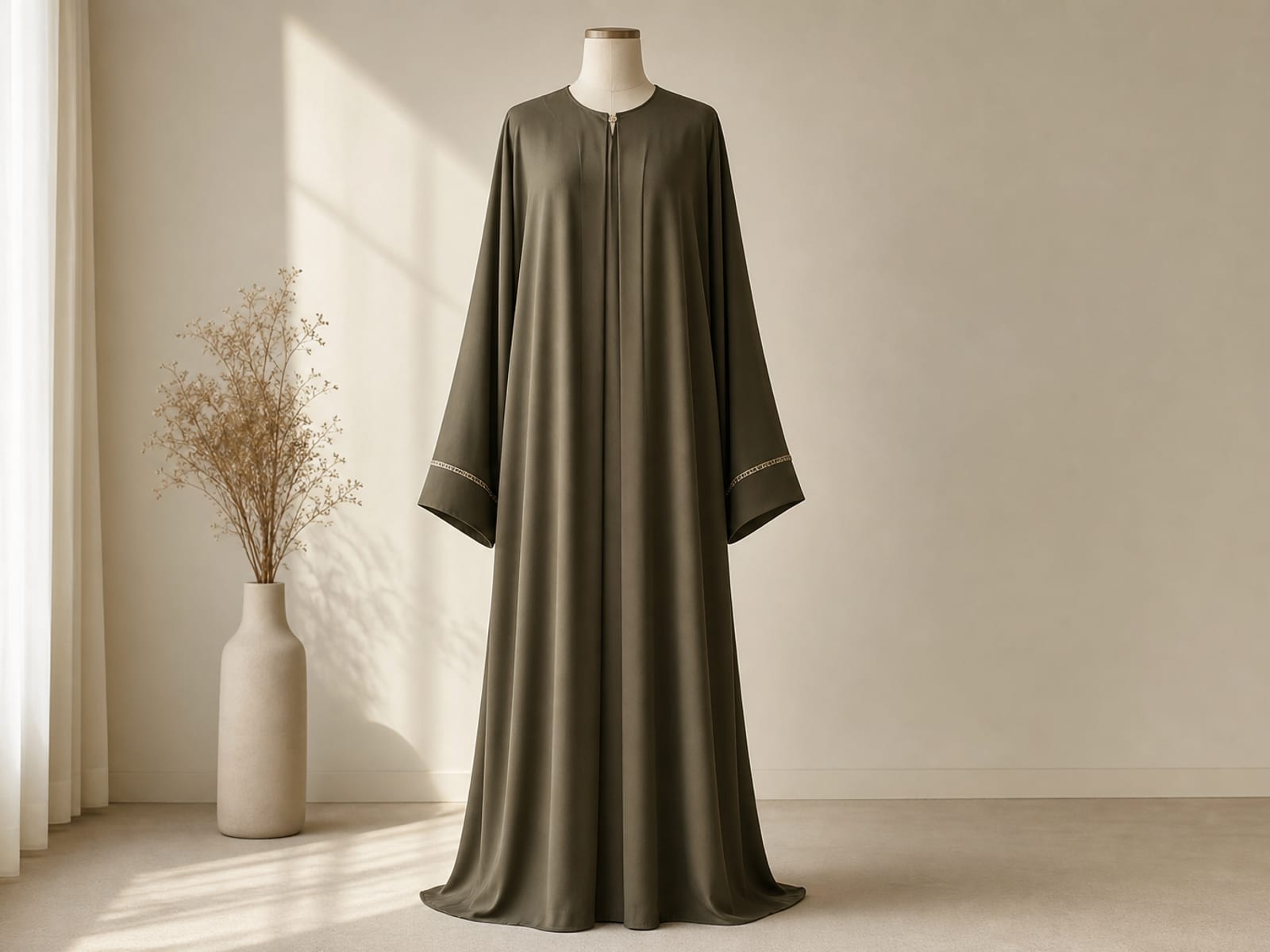
Fabric and lining: two decisions that cannot be separated
On a dress the fabric and the lining have to be chosen together. A chiffon dress without a considered lining is a coverage problem in a hot climate; the same dress lined in a heavy fabric becomes a winter product. Crepe and nida carry structure and opacity without much lining, and jersey suits the relaxed, easy-care end of the range.
The fabric library compares materials on opacity, drape, breathability and season, which is where most of the dress sourcing conversation actually happens. Bring the fabric decision forward and the rest of the specification follows it.
- Unlined — for opaque fabric and warm markets where weight matters
- Fully lined — for coverage, structure and a smooth hang
- Partly lined — bodice lined, sleeve sheer, the most common occasion specification
- Attached inner slip — for open-front and layered styles
- Lining matched or contrasted to the shell colour, decided at sampling
| Selling brief | Shell fabric | Lining direction |
|---|---|---|
| Everyday dress that must reorder | Nida or crepe | Unlined or light lining, confirmed at sampling |
| Layered or occasion look | Chiffon | Full lining or double layer to reach the coverage you sell |
| Premium evening position | Satin or viscose | Lining chosen for hang rather than weight |
| Travel and easy care | Jersey | Usually unlined, with opacity confirmed on the sample |
Size and measurement: three numbers that decide the fit
Unlike a hijab, a dress carries full sizing risk. Bust, waist and hip drive the fit; length is the fourth decision and the easiest one to get wrong across markets. Send the chart you sell to, or ask for ours and mark the rows you want changed.
We record the values per style on the approved sample, so bulk pieces are measured against a sealed reference rather than against a letter size.
- Petite, regular and tall length runs, or one fixed length per market
- Plus size grading on bust, waist, hip and sleeve rather than length alone
- Buyer-supplied measurement charts, including market-specific letter sizes
- Measurement tolerance agreed in writing before bulk production starts
| Measurement | Where it is measured | Confirmed value |
|---|---|---|
| Bust | Pit to pit, measured flat across the front | — |
| Waist | Narrowest point of the garment, flat | — |
| Hip | Widest point of the garment, measured flat | — |
| Garment length | Shoulder point to hem, or from the waist seam where the style has one | — |
| Sleeve length | Shoulder point to cuff | — |
| Measurement tolerance | Accepted variation, recorded in the approved specification | — |
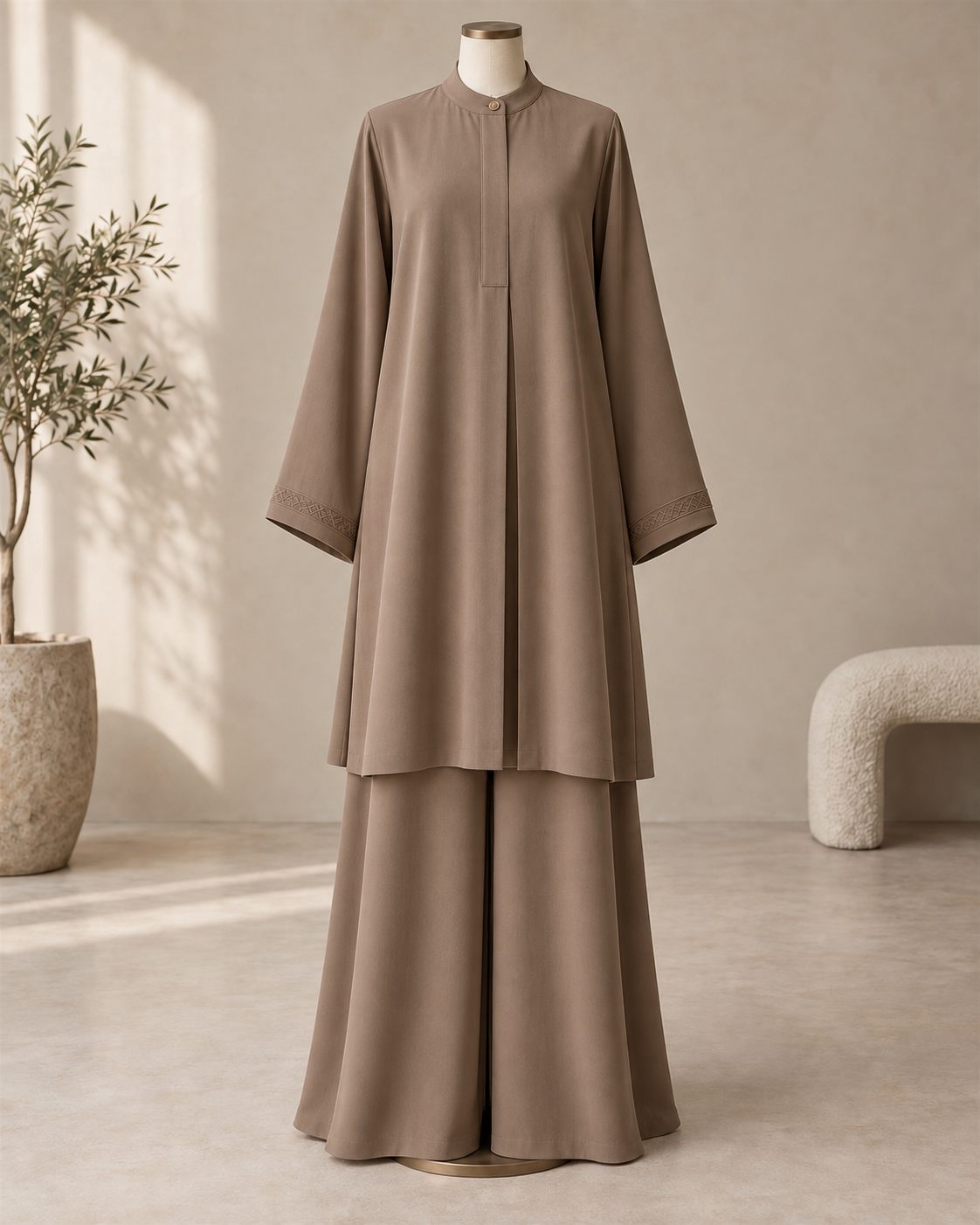
Length, hem and sleeve: the details customers notice first
Length is the most visible number on a dress and the one most often quoted differently between buyer and supplier. Decide where you measure from, in which unit, and how much variation is acceptable, then put it in the specification rather than in an email thread.
- Length measured from shoulder point or from waist seam, stated explicitly
- Hem finish — straight, curved, slit or side-vented
- Sleeves — long, three-quarter, cuffed, flared, elasticated or sheer
- Neckline and closure — buttoned, zipped, concealed placket or pull-on
- Pockets, belts and ties specified per style so bulk matches the sample
Colour and print for dress ranges
A dress range is usually narrower in colour than a hijab range and wider in print, because the dress carries the whole look. Plan the core solids that will sell for a full season, then decide how much of the buy should be seasonal or printed stock.
- Core solids for year-round selling, kept consistent between orders
- Seasonal and Eid shades added alongside the core range
- Occasion colours with contrasting lining or trim, specified separately
- Printed designs approved on the final shell fabric before bulk
- Dye-lot handling agreed when a shade is repeated across an order
MOQ: what moves the minimum on a dress order
Contact us for current MOQ — a dress order is usually quoted by style and colourway, so a single figure for the category would not be accurate.
Dress minimums are driven by the number of styles and colourways rather than by the total quantity, because every colourway is cut and produced as its own line. Printing and decoration add setup on top of that.
- Plain styles in a running fabric normally carry the lowest minimum
- Lining adds a second fabric line to the same style
- Embroidery, beading and rhinestone work add setup per design
- Custom colour, custom label and retail packing are quoted per order
Ready stock or made to order for a dress range
Ready stock is the safer way to test how a dress cut sells, because you can put it on the rail without a sampling round. Made to order is how a brand owns the design: your pattern, your fabric, your measurements and your label.
- Ready stock — running styles in listed fabrics and colours, subject to availability
- Made to order in a running fabric — your colour, size run and label
- Made to order from a tech pack — pattern development, sample approval, then bulk
- Mixed orders — ready stock for the current season, made to order for the next
Label, branding and retail packing
On a dress the label sits at the neck, on show, and the care label carries obligations in many markets. Provide the exact text you need and it will be produced as specified.
- Woven label, printed label and side-seam label to your artwork
- Hang tag, header card and price tag
- Care and fibre text printed from the wording you provide
- Folded packing in poly bag, or hanging packing for retailers who display straight from the carton
- Gift box or garment bag for occasion and premium ranges
- Matching hijab packed with the dress where the range includes one
Sampling: the four things approval locks down
A dress sample is approved on fit, fabric, colour and finish. Everything that will be argued about in bulk is visible at this stage, which is why the sample review is worth more time than the sample cost suggests.
Send the brief: market, occasion, price position and quantity range.
Confirm shell fabric and lining together, against swatches.
Agree the measurement sheet, length point and tolerance in writing.
Produce the first sample in the agreed fabric, colour and lining.
Review fit, drape, hem line, sleeve and closure behaviour.
Approve and seal the sample, recording any revision in writing.
Release bulk only against the sealed approved sample.
Quality control: the dress defects that reach customers
A dress has more construction than a scarf or an abaya, so there are more places for a fault to appear. These are the checks that catch them before packing.
- Measurement drift between sizes — checked against the approved sheet, piece by piece
- Lining too short, twisted or unattached — checked by turning the garment inside out
- Zips, buttons and hooks that fail or gape — tested open and closed, not just counted
- Puckered seams and skipped stitches — checked at the side seam and sleeve insertion
- Hem line uneven or twisted — checked flat and on a form
- Colour variation between pieces of the same order — checked against the approved swatch
- Embroidery and beading placement — checked against the approved artwork
- Packing errors — the wrong size or colour in a sold pack, checked at packing inspection
Wholesale ordering: what we need from you
Dress enquiries are quoted faster when the measurement sheet is attached, even if it is incomplete. Mark the rows you are unsure about and we will propose a specification with the reason it should work for your market.
Business type: boutique, online seller, brand, reseller or distributor.
Target market and the occasion the styles will sell into.
Styles: everyday, occasion, lined, printed or a custom design.
Fabric and lining direction, or a request for a recommendation.
Size run, length point and unit of measurement.
Colour and print direction, with artwork if the design is yours.
Label and packing requirements.
Quantity range and target delivery window.
Shipping, packing format and consolidation
Dresses can be folded or supplied on hangers, and the choice affects carton size and freight. Tell us which you need before the order is packed, because repacking is a cost that no one wants to pay twice.
- Folded packing for economical freight, or hanging packing for display
- Dresses consolidated with abayas, hijabs and accessories in one shipment
- Itemised packing list and carton marks supplied before dispatch
- Export documents and origin paperwork: available upon request
- Lead time depends on design and order quantity
View collection
Everyday modest dresses
- Long-sleeve maxi modest dress
- Relaxed A-line modest dress
- Abaya-style dress with open front
- Modest dress with side pockets
Occasion and evening
- Embroidered occasion dress
- Beaded evening modest dress
- Satin modest dress
- Layered chiffon occasion dress
Lined and layered
- Fully lined modest dress
- Double-layer chiffon dress
- Dress with attached inner slip
- Opaque body with sheer sleeve dress
Comfort and at-home
- Viscose relaxed modest dress
- Jersey house dress
- Knit travel dress
- Loose-fit modest dress, elasticated waist
Printed and patterned
- All-over printed modest dress
- Border print modest dress
- Floral printed modest dress
- Buyer artwork printed dress
Custom and private label
- Custom dress from tech pack
- Private label dress range
- Buyer measurement chart dress
- Buyer colour card dress
Frequently asked questions
Send the style, fabric direction, lining, size run, colour count and destination. Dress pricing moves with the number of colourways and the amount of construction, so a quote without those details would not be usable. Contact us for current MOQ at the same time.
No. An abaya is an outer garment worn over other clothing and is usually cut loose and unshaped. A modest dress is a complete outfit with its own bust, waist and hip measurements, so it carries real sizing risk and needs a measurement sheet rather than a length decision alone.
Yes, and most boutiques do. A combined order gives a complete rail, and everything consolidates into one shipment with one packing list, which keeps freight and customs handling simpler.
Sell to one market first, or order the dress in the size run that market already buys. When you add a market, add its measurements to the sheet instead of renaming a letter size, and confirm the change on a sample before bulk.
Yes. A tech pack with a sketch, measurements and construction notes is enough to start pattern development. If you do not have one, send a reference garment or clear photographs with measurements and we will work from those.
Yes, and it should be decided with the shell fabric rather than after it. Unlined, partly lined, fully lined and attached-slip options behave differently in heat and in the wash, so the choice is confirmed on the sample.
Planning your next modest fashion collection?
Tell us these seven things and we can come back with a workable sourcing plan instead of a price list.