Wholesale Hijab Accessories: Magnets, Inner Caps and Underscarves
Accessories are the cheapest way to raise order value and the easiest category to get wrong on packing. What a buyer wants in Jeddah is not what a buyer wants in Kuala Lumpur or Manchester, and the differences are specific rather than vague.
What counts as a hijab accessory, and what does not
An accessory is a piece sold alongside the scarf rather than instead of it: closures, pins, inner caps, underscarves and bands. A second scarf is not an accessory, and neither is a garment. Keeping the line clear matters because the MOQ, the packing and the labelling all behave differently on small items.
The commercial point is that accessories attach to an existing order. A boutique that buys forty abayas can add two hundred magnets to the same carton for very little extra freight, and the magnets carry a margin a garment cannot. That is why this category is usually built after the main line, not before it.
- Closures: magnets, pins, brooches
- Head layers: inner caps, underscarves, bonnets
- Base layers: bands, turban bases
- Presentation: header cards, pouches, gift boxes
What changes by market
Accessories are the most market-specific part of a modest wear range, because they are bought on habit rather than on trend. Gulf buyers tend to standardise on magnetic closures and expect a finished look — gold-tone or pearl caps, a small gift box, a card that can hang. Weak magnets are returned as a fault, so strength matters more than price.
In Malaysia and Indonesia the square printed scarf is the base product, and the accessories that sell with it are cotton inner caps, seamless tube underscarves and wide bands, usually in multi-packs at a low unit price. Buyers there ask about breathability and whether the cap stays cool in humidity before they ask about finish.
European buyers order smaller quantities and ask more often about fibre content and recycled yarns, and they want neutral tones that photograph well on a plain background. North American buyers are the most likely to want single-unit retail packaging: a carded magnet set or a boxed gift, because the accessory is sold as a small add-on online rather than in bulk on a counter.
None of this changes the product. It changes the pack, the colour range and the quantity, which is exactly what a quotation has to state.
- Gulf: magnet closures, gold or pearl finish, gift pack
- Southeast Asia: cotton caps, tube underscarves, multi-packs, breathability
- Europe: neutral tones, fibre and recycled-yarn questions, smaller runs
- North America: single-unit retail cards, boxed sets, online-first packing
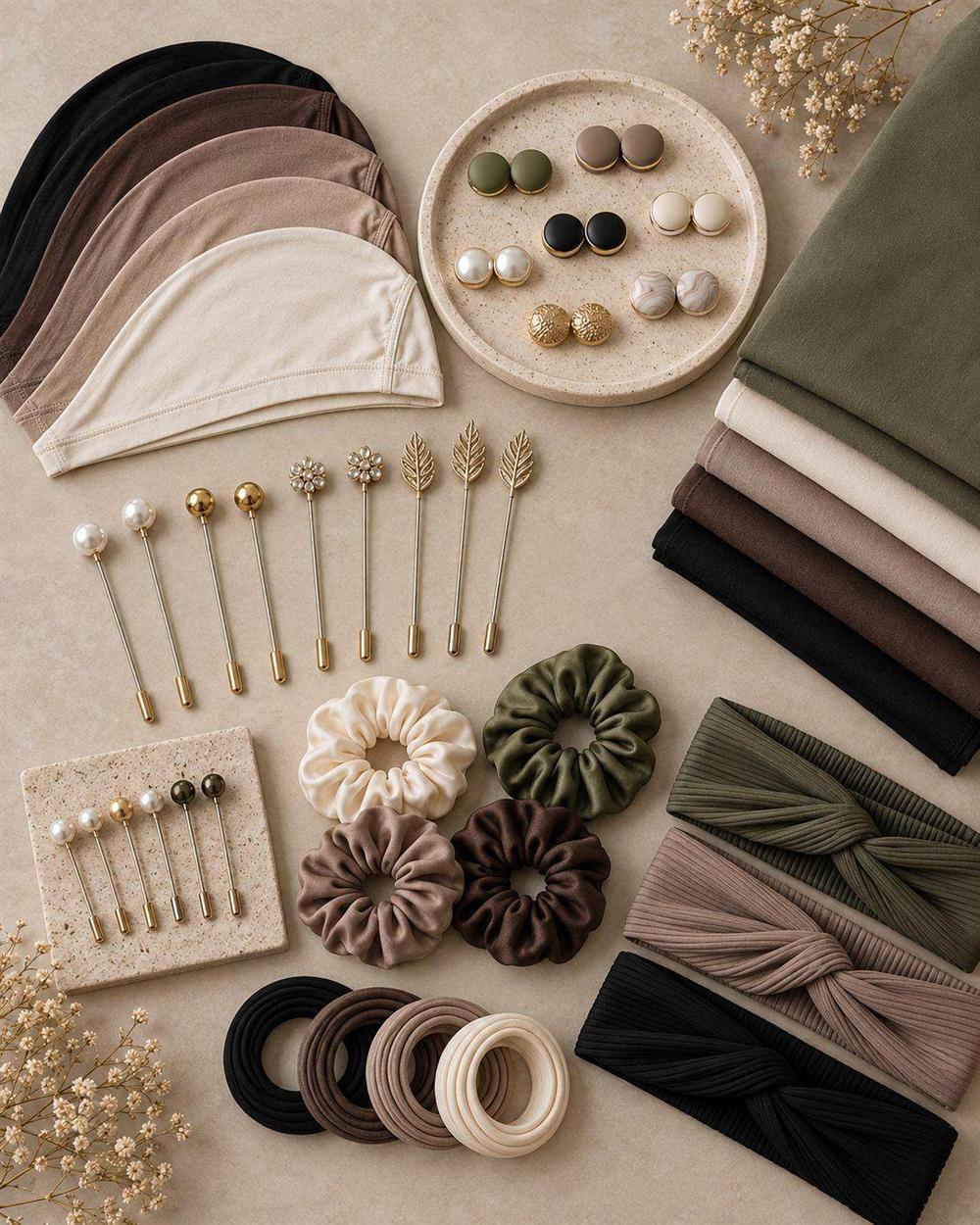
Magnets: the closure most buyers standardise on
Magnet strength is not visible in a photo. Ask for a sample pair and test it on the fabric weight you actually sell.
A magnetic closure is two discs held by a magnet, sewn into a fabric pocket or fixed to the scarf. The two variables that matter are the pull strength and the finish. Too weak and the scarf slips; too strong and it puckers fine chiffon, which is why buyers with lightweight scarves sometimes stay on pins.
Ask for the diameter and the finish before ordering, and check whether the magnet is sewn into a pocket or bonded. Sewn pockets survive washing better; bonded pairs are cheaper and flatter. The failure mode is rust after repeated washing, so plating quality is worth a direct question.
Pins and brooches: smaller volume, different risk
Pins remain in demand where customers consider a magnet too strong for a fine weave, and they cost less per unit. The trade-off is a sharp point against skin and fabric, and a brooch that can mark a scarf if it is stored pinned.
If you stock pins, specify the plating: brass and nickel both discolour differently, and a cheap pin that rusts leaves a permanent mark on the scarf, which turns a two-dollar accessory into a returned garment.

Inner caps and underscarves: the repeat-purchase piece
The inner cap is the accessory customers buy again and again, because it wears out faster than the scarf and it decides comfort. Cotton jersey is the volume product: breathable, stretchy and cheap enough to sell in a pack. A tie-back bonnet suits customers who need the cap to stay put without an elastic line across the forehead.
In hot climates the question is whether the cap traps heat, and the answer is mostly about fabric weight rather than fibre. A thin cotton jersey outperforms a thicker cotton blend that looks more substantial on a hanger.
Tube underscarves are the simplest shape and the easiest to pack, but they offer no adjustment. Where customers tie their own scarf tightly, a tube can be the wrong choice regardless of quality.
- Cotton jersey cap: volume product, breathable, low unit price
- Tie-back bonnet: stays put without an elastic line
- Seamless tube: simplest packing, no adjustment
- Lace-edge cap: occasion wear, higher margin, lower volume
Bands and turban bases
A wide jersey band is the cheapest way to add volume under a scarf, and a cross-front base is what makes a turban hold its shape without pins. Both are low-cost, light to ship and easy to add to a colour range.
The sizing is the difficulty: a band that is too tight leaves a mark, and one that is too loose slides. Ask for the flat and stretched circumference, not just "free size".

Colour matching: the accessory has to sit with the scarf
An accessory sold next to a scarf is judged as a set, so the tone has to match under retail light rather than on a screen. Ask for the accessory and the scarf to be cut from the same dye lot, or at least photographed together before dispatch.
Where an exact match is not possible, a deliberate contrast sells better than a near-miss. A cream cap under an ivory scarf reads as a mistake; a charcoal cap under the same scarf reads as a choice.
Pack counts and retail format
Decide the pack count before quoting. The same magnet costs very differently as a loose pair and as a carded set of three.
Accessories are usually sold by pack count rather than by unit: five or ten caps to a bundle, two magnets to a card, three bands in a pouch. The pack count is a commercial decision, because it sets the retail price point and the shelf space the item occupies.
For gifting markets, a small box with a printed insert converts a low-value item into a presentable one at modest cost. For online markets, a flat card with a hang hole is more practical than a box, because it ships as a letter and photographs cleanly.

MOQ on accessories: small items, different logic
Small items are often made in batches per colour and per pack format, so the minimum applies to the combination rather than to the total. Mixing five colours across three pack formats can multiply the minimum even when the total unit count looks modest.
The practical approach is to narrow the range first: pick two or three colours and one pack format, confirm that minimum, then add colours once the item is selling.
- Minimum usually applies per colour and pack format
- Custom cards raise the minimum more than custom colour
- Combining accessories with a garment order can improve the freight economics
Sampling and quality control
Accessories are checked physically rather than visually. For magnets, a pull test on the fabric you actually sell. For caps, the seam and the elastic recovery after stretching. For pins, the plating and the point. For packaging, whether the card creases in transit.
Inspect the first carton rather than the sample alone: packing is where small items fail, because a loose magnet in a carton scratches everything around it.
Approve a physical sample on your own fabric
Confirm pack count, card size and carton arrangement
Inspect the first carton before the balance ships
Keep a reference unit from each batch
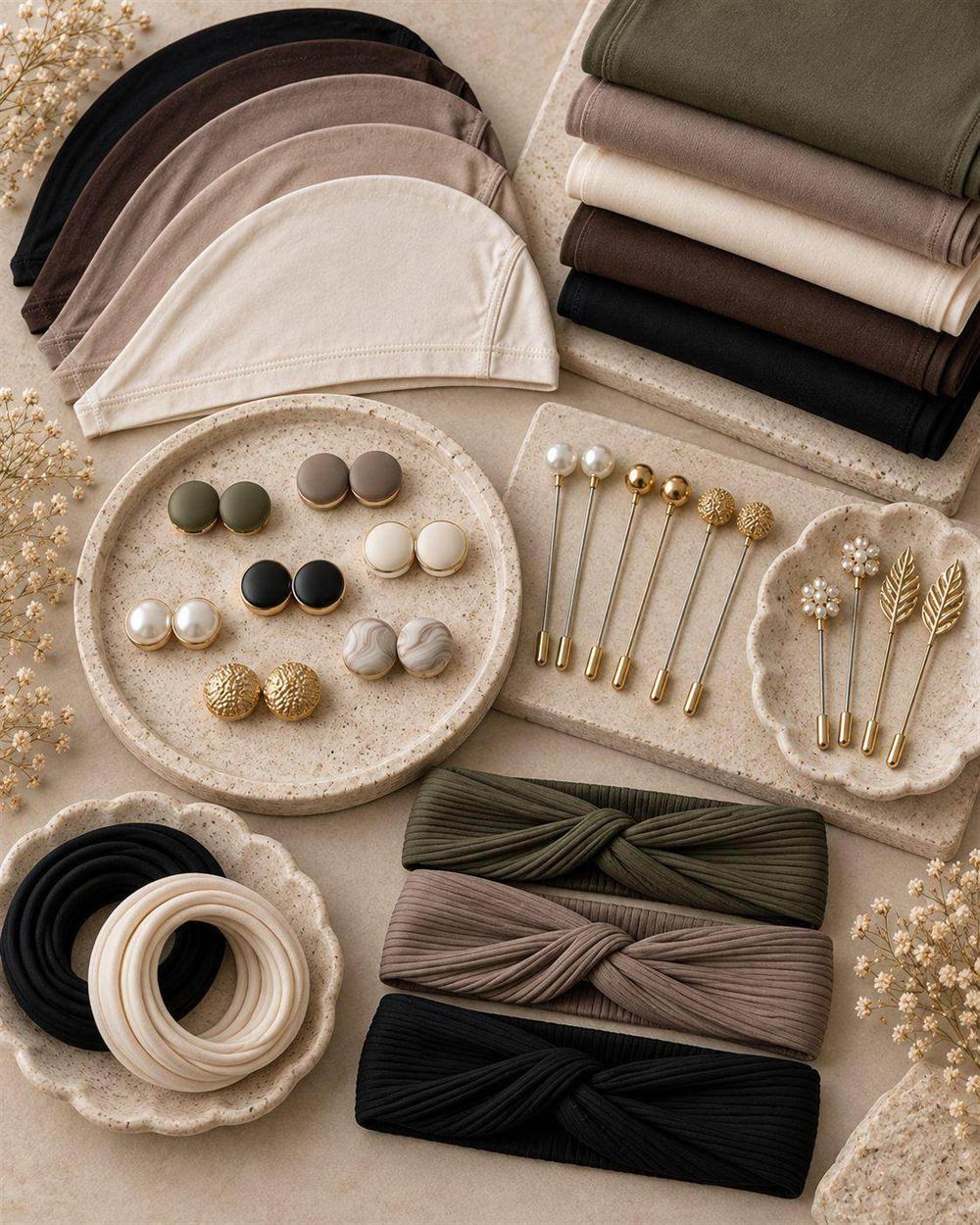
Labelling and private label on small items
There is rarely room for a woven label on a magnet or a cap, so branding usually moves to the card, the pouch or the box. That is an advantage: a printed card carries a logo, a fibre line and a barcode at once, and it can be changed between runs without touching the product.
If the accessory is packed with a garment, decide whether the branding appears on both. A branded scarf next to an unbranded cap looks like an assembled set rather than a product.
Shipping accessories with a garment order
Accessories are light and compact, so they rarely change the carton count on their own. Where they do, it is because of packaging: a gift box takes volume a flat card does not, and a display unit takes volume nothing else does.
Send the pack format with the enquiry so freight can be estimated on the real carton, not on the unit weight of the item.

How to brief an accessory enquiry
Send the item type, the market you sell into, the colours, the pack format, the quantity and the destination. The market matters more here than in any other category: it decides the pack, the finish and often the fabric, and it is the detail most enquiries leave out.
View collection
Magnetic closures
- Round magnet pair, matte finish
- Magnet with pearl or gold-tone cap
- Magnet with sew-in fabric pocket
Pins and brooches
- Safety pin, brass or nickel
- Decorative brooch pin
- Straight pin with pearl head
Inner caps and underscarves
- Cotton jersey inner cap
- Tie-back cotton bonnet
- Tube underscarf, seamless
- Lace-edge cap for occasion wear
Bands and turban bases
- Wide jersey band
- Cross-front turban base
- Pleated band
Retail display and packing
- Printed header card
- Organza or cotton pouch
- Gift box with insert
- Counter display unit
Custom and private label
- Own-brand header card
- Custom magnet colour
- Custom pouch size
Frequently asked questions
The minimum usually applies per colour and per pack format rather than to the total unit count. Tell us the colours and the pack format you want and we confirm the current MOQ for that combination before quoting.
Magnetic closures are the usual choice there, generally in a matte, gold-tone or pearl finish, and buyers often expect a carded or boxed presentation. Ask for a sample pair to test on the fabric weight you sell, because a magnet that is too strong puckers lightweight chiffon.
They are normally sold in pack counts of five or ten rather than as single units, because the retail price point works better that way. The pack count is agreed with the order and affects both the carton volume and the carton cost.
Yes, most often through a printed header card, a pouch or a gift box rather than a woven label, since small items have no seam to carry one. Card changes are quoted with the order and depend on quantity.
Only when both are cut from the same dye lot. We check and photograph the pair together where an exact match is required. Where a match is not possible, a deliberate contrast usually sells better than a near-match.
Yes, and it usually improves the freight economics because accessories add little weight or volume relative to their value. Send the garment order reference and the accessory list together so they can be packed and quoted as one shipment.
Planning your next modest fashion collection?
Tell us these seven things and we can come back with a workable sourcing plan instead of a price list.