Wholesale Modest Sets: Two Piece, Three Piece, Top and Skirt or Pants
A set sells as one look but is produced as two or three garments, so the buying decisions are fabric matching, size pairing and how the pieces are packed together.
Who buys wholesale modest sets, and what a set has to do
A set removes a decision for the customer: the outfit is already resolved, so the sale depends on fit, colour and presentation rather than on styling. That is why sets sell well in social commerce, on hangers in a boutique and as gifting, and why buyers ask for them even when separates already sell.
It also changes the sourcing brief. A set is produced as two or three garments, so the buyer is managing fabric matching between pieces, a size pairing decision and a packing specification that keeps the pieces together. Those three points are what this page is built around.
- Boutiques that want display-ready looks rather than separates
- Online and social commerce sellers who need a complete outfit in one listing
- Modest fashion brands building a private label set range
- Wholesalers and distributors who need several set shapes at several price positions
- Occasion and Eid buyers who sell decorated sets in a fixed window
- Gifting sellers who need packaged, presentable outfits
How the set range is grouped
Sets are grouped by how many pieces they contain and by whether the bottom is a skirt or pants, because that is how buyers describe them and how they are packed. The groups further down this page list the styles we can supply and develop; a mixed order across groups is normal.
- Two piece — top with skirt or pants, the entry point for most ranges
- Three piece — the same idea with an inner slip, an outer layer or a hijab
- Top and skirt — where the skirt fall and hem line carry the design
- Top and pants — easier to wear, easier to pack and easier to sell all year
- Occasion sets — decoration, satin and layering for the season
- Custom sets — your pattern and label across every piece
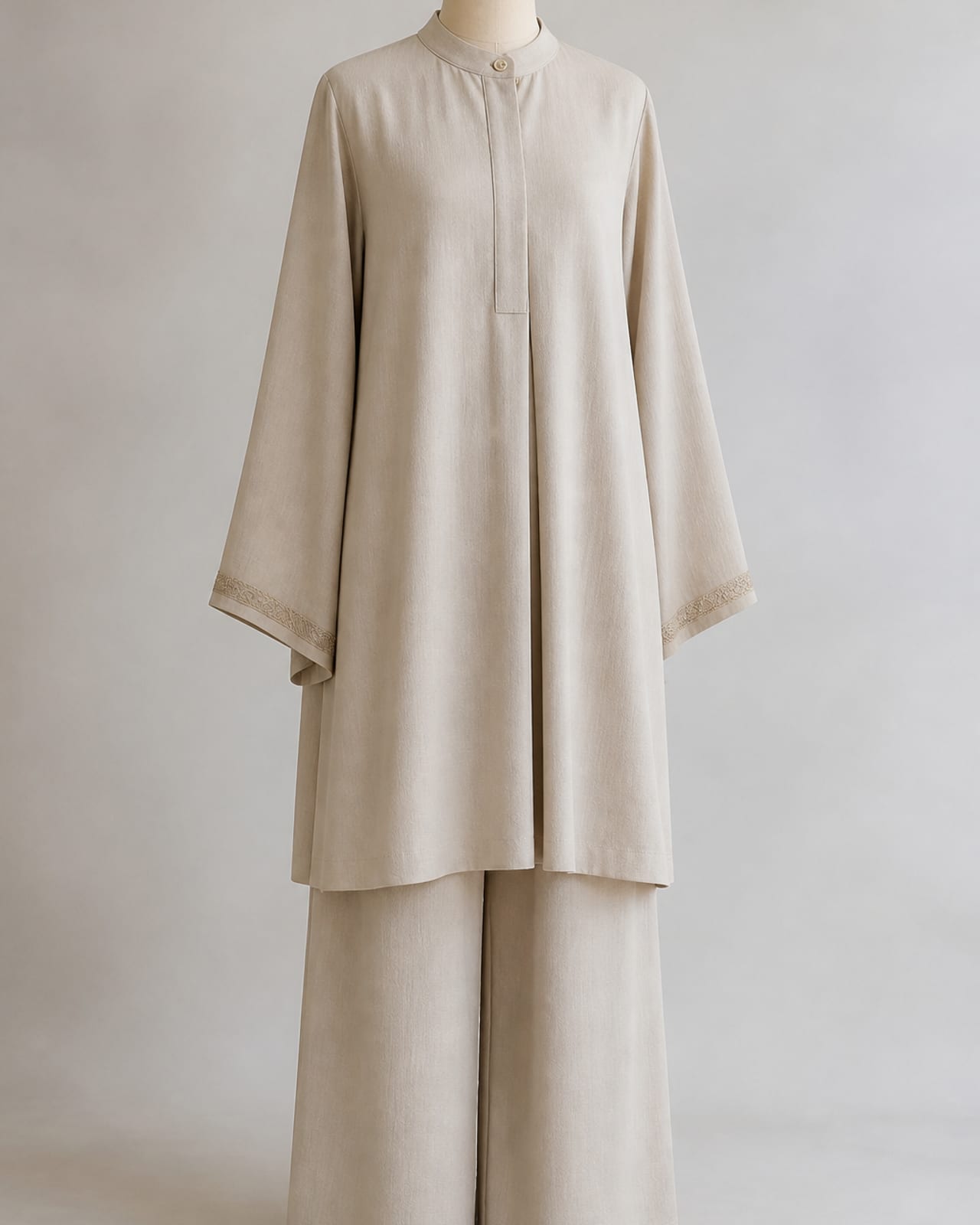
Fabric: the pieces must behave as one garment
Approve a finished pair, not a fabric swatch — the top and the bottom have to look like one outfit under shop lighting, not only on a flat table.
The risk specific to sets is fabric and colour matching between the pieces. Cut from different lots and the top can read slightly warmer than the skirt under shop lighting, which is exactly the kind of difference a customer notices and a supplier cannot explain away. The fix is a single lot per order and a checked reference pair.
Crepe and nida are the workhorse set fabrics because they hold shape across a top and a bottom without heavy lining. Jersey suits relaxed, travel-friendly sets, and chiffon is used for layered occasion sets where coverage is handled by an inner slip. The fabric library explains how each behaves across two garments.
- Single lot per order — top and bottom cut from the same fabric batch
- Lining used in one piece and not the other, decided deliberately rather than by accident
- Same-fabric options for tops that need more weight than the bottom
- Contrast trim or piping only where both pieces are produced from the same trim roll
- Print sets where repeat and placement are checked across both pieces before cutting
Sizing a set: two garments, one size label
A set is sold under one size label but has to fit two garments, and the top and bottom do not always grade in step. Decide whether the set is sized as a unit or offered as a matched pair with separate top and bottom sizes, then write it into the specification. Buyers who skip this step find out at the returns stage.
Values are recorded on the approved pair for each style, so bulk pieces are measured against a sealed reference rather than a letter size.
- Set sized as a unit, with the top and bottom graded together
- Matched pair with separate top and bottom sizes, for customers who need it
- Size-ratio packs, where the shop chooses how many of each size it buys
- Plus size and tall runs graded across both pieces, not lengthened only
| Piece | What is recorded | Confirmed value |
|---|---|---|
| Top — bust | Pit to pit, measured flat at the front | — |
| Top — length | Shoulder point to hem, and the point of measurement stated | — |
| Bottom — waist | Relaxed and extended measure for elasticated waists | — |
| Bottom — hip | Widest point, measured flat on the bottom piece | — |
| Bottom — length | Waistband to hem | — |
| Measurement tolerance | Accepted variation, written into the approved specification | — |
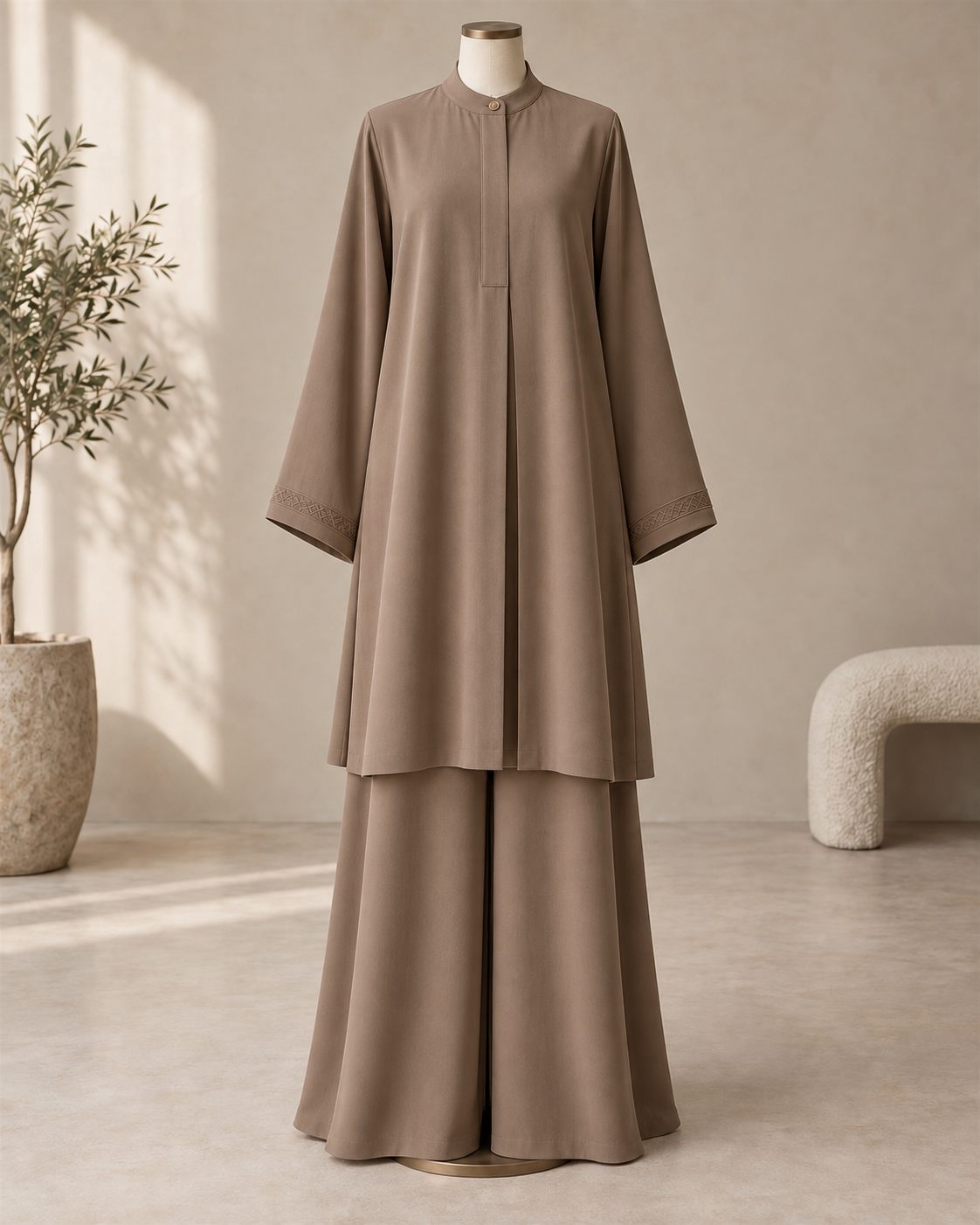
Colour and coordination across the pieces
Sets usually sell in a narrower palette than separates, because the outfit is the statement and the customer is buying a finished look. Build the core shades first, then decide how much of the buy should be seasonal or decorated stock.
- Core solids kept consistent between orders so a set can be reordered
- Seasonal and Eid shades planned with the collection
- Contrast lining, trim or belt colours specified as separate lines
- Dye-lot handling agreed across both pieces when a shade repeats
- Print sets approved on the constructed pair, not on flat fabric
MOQ: what a set order actually asks for
Contact us for current MOQ — tell us how many colourways and shapes you are planning and we will quote the set structure rather than a single number.
A set consumes more fabric, more cutting and more finishing than a single garment, and it is produced in pairs rather than pieces. That means the minimum is normally described in sets, and it moves with how many colourways and shapes are in the order.
- Plain two piece sets in a running fabric carry the lowest minimum
- Three piece sets add a third construction and a third quality check
- Embroidery, beading and satin work add setup per design
- Size-ratio and retail-ready packs are quoted with the packing included
Ready stock or made to order for a set
Ready stock lets a buyer put a set on the rail without a sampling round, which is useful for testing whether the shop's customer accepts a set format at all. Made to order is how a brand owns the outfit: your pattern, your fabric, your pairing rule and your label.
- Ready stock — running set styles in listed fabrics and colours, subject to availability
- Made to order in a running fabric — your colour, size pairing and label
- Made to order from a tech pack — pattern development, sample pair approval, then bulk
- Mixed orders — ready stock sets alongside made-to-order sets in one shipment
Label, branding and packing a set
Branding a set is a question of consistency: the labels, tags and packing should look like one product, not like two garments that happen to arrive together. Decide the label positions and the pack format while the set sample is being approved.
- Woven label, printed label and care label on both or all pieces
- Side-seam label as an alternative where a neck label interrupts the design
- Hang tag and price tag on the set rather than on the pieces
- Folded as one bundle in a printed poly bag, so the pieces cannot be separated in the box
- Retail packing with tissue, box sleeve or gift box for gifting
- Care and fibre text printed to your supplied specification
Sampling a set: approve the pair, not the pieces
The set sample is where fabric matching, size pairing and packing are settled. Reviewing the top and bottom separately is what allows a colour mismatch to survive into bulk, so the sample is reviewed as a finished outfit.
Send the brief: market, occasion, set shape and quantity range.
Confirm the fabric for both pieces from one lot, against swatches.
Agree the measurement sheet for the top and the bottom separately.
Decide the pairing rule: sized as a unit, or matched separate sizes.
Produce the sample set and review it on a form as one outfit.
Check colour, print alignment and trim across both pieces.
Seal the approved pair with its specification and packing instruction.
Quality control: what goes wrong on set orders
Set complaints are usually about the relationship between the pieces rather than about either piece alone. These are the checks that catch them before the carton is closed.
- Colour mismatch between top and bottom — checked as a pair against the approved set
- Size mismatch inside a sold set — the top and bottom paired and checked together
- Missing pieces — completeness checked against the pack specification
- Measurement drift within a size — checked against the approved sheet
- Print misalignment between pieces — checked against the approved pair
- Seam, hem and closure faults — checked at finishing on both pieces
- Lining faults — checked with the garment turned inside out
- Packing errors — the wrong size or colour bundled as a set, checked at packing inspection
Wholesale ordering: what a set order needs
A set enquiry that names the shape, the pairing rule and the packing can be quoted and sampled without a second round of questions. If any of those are open, say so and we will propose an option for your market.
Business type: boutique, e-commerce seller, brand, wholesaler or distributor.
Target market and whether the set sells as everyday, occasion or gifting.
Set shape: two piece, three piece, top and skirt, or top and pants.
Fabric direction for the whole set, or a request for a recommendation.
Size run and pairing rule, or a request for our measurement sheet.
Colour direction for both pieces, including any contrast trim.
Label, tag and packing requirements, including whether the set is bundled.
Quantity in sets and target delivery window.
Shipping sets and consolidation
Sets are bulkier than separates but they carry more retail value per carton, so consolidation is worthwhile: sets can travel with abayas, dresses and hijabs from the same order. Sets are usually packed as bundles, which keeps the pieces together from packing line to shelf.
- Bundled packing so the pieces of a set stay together in the carton
- Sets consolidated with other categories in one shipment
- Packing list and carton marks per bundle, issued before dispatch
- Export documents and origin paperwork: available upon request
- Carton dimensions and weights provided for your forwarder
- Lead time depends on design and order quantity
View collection
Two piece modest set
- Two piece set, top and skirt
- Two piece set, top and pants
- Two piece set, tunic and wide leg pants
- Two piece set with contrast trim
Three piece modest set
- Three piece set with inner slip
- Three piece set with outer layer
- Three piece set with matching hijab
- Three piece set, top, skirt and belt
Top and skirt set
- Top and A-line skirt set
- Top and pleated skirt set
- Top and maxi skirt set
- Top and layered skirt set
Top and pants set
- Top and wide leg pants set
- Top and straight leg pants set
- Top and elasticated waist pants set
- Tunic and pants set, printed
Occasion sets
- Embroidered occasion set
- Beaded top and skirt set
- Satin two piece set
- Chiffon layered set
Custom and private label sets
- Custom set from tech pack
- Private label set range
- Buyer measurement chart set
- Buyer colour card set
Frequently asked questions
Sets are quoted per set rather than per piece, and the minimum moves with the number of colourways and shapes in the order. Contact us for current MOQ and tell us how many set designs you want to test.
Yes, as a matched pair. Tell us whether you sell the set under one size label or as a pair with separate top and bottom sizes, and the pairing rule goes into the specification so bulk packing follows it.
Normally yes. Set bundles keep the pieces together from packing to shelf and prevent the size or colour mismatches that happen when pieces are packed loose. If your stockroom prefers separates, that can be specified instead.
Yes. A matching hijab can be produced as part of a three piece set or packed alongside a two piece set, and it can carry the same label and band as the rest of the outfit.
You can, and some buyers do, but it changes the order: the pieces then need their own size labelling and their own packing specification. Tell us up front if separates are planned, because it affects how the set is graded.
Both pieces are cut from one fabric lot per order, and the finished pair is checked against the approved sample under controlled light. Colour matching is also agreed for repeat orders, because a reordered top must still match the skirt already on the rail.
Yes. Send a sketch, reference photographs or a tech pack with measurements. We confirm the construction and the size pairing, then develop the sample as one outfit so both pieces are approved together.
Planning your next modest fashion collection?
Tell us these seven things and we can come back with a workable sourcing plan instead of a price list.