Muslim Dress Wholesale: The Category With the Highest Fit Risk
Dresses sell well and fail loudly, because a dressed customer notices a bad fit immediately. This page covers the silhouette, sizing and fabric decisions behind a repeatable dress range.
What a buyer means by a muslim dress
The phrase covers several different garments, and the first job in any enquiry is agreeing which one is being bought. A loose everyday dress, a formal kaftan, a layered occasion piece and a co-ord set all get called a muslim dress, and they have different costs and different fit behaviour.
If you sell into a market that buys dresses as everyday wear, the product is a comfortable, coverable, washable garment. If your market buys for occasions, decoration and drape carry the price. Those are different ranges and they should be ordered separately.
- Everyday loose dress — coverable, comfortable, easy care
- Kaftan and wide-cut styles — drape-led, comfortable in heat
- Occasion dress — decorated, lined, higher price tier
- Layered dress — an under-layer and an over-layer as one product
- Co-ord with matching hijab — sold as a complete outfit
Silhouette: the first decision that changes the cost
Silhouette decides fabric consumption, pattern work and how forgiving the garment is to wear. A wide, straight cut uses fabric generously and hides fit variation; a shaped dress uses less fabric but demands a more accurate size run.
For a first order, the forgiving silhouettes are the safer commercial choice. They reduce returns, they suit a wider range of body shapes, and they allow a smaller size run to cover the same customer base.
| Silhouette | Fit forgiveness | Fabric use | Best for |
|---|---|---|---|
| Straight, loose | High — covers variation in waist and hip | Generous | Everyday ranges and first orders |
| A-line | High below the waist, requires chest accuracy | Moderate | Retail ranges with a defined shape |
| Kaftan, wide cut | Very high — the most forgiving shape | Highest | Hot climates and occasion wear |
| Tiered or panelled | Moderate — panelling restricts | High | Statement and seasonal styles |
| Shaped / fitted | Low — demands accurate sizing | Lowest | Brands with an established size chart |
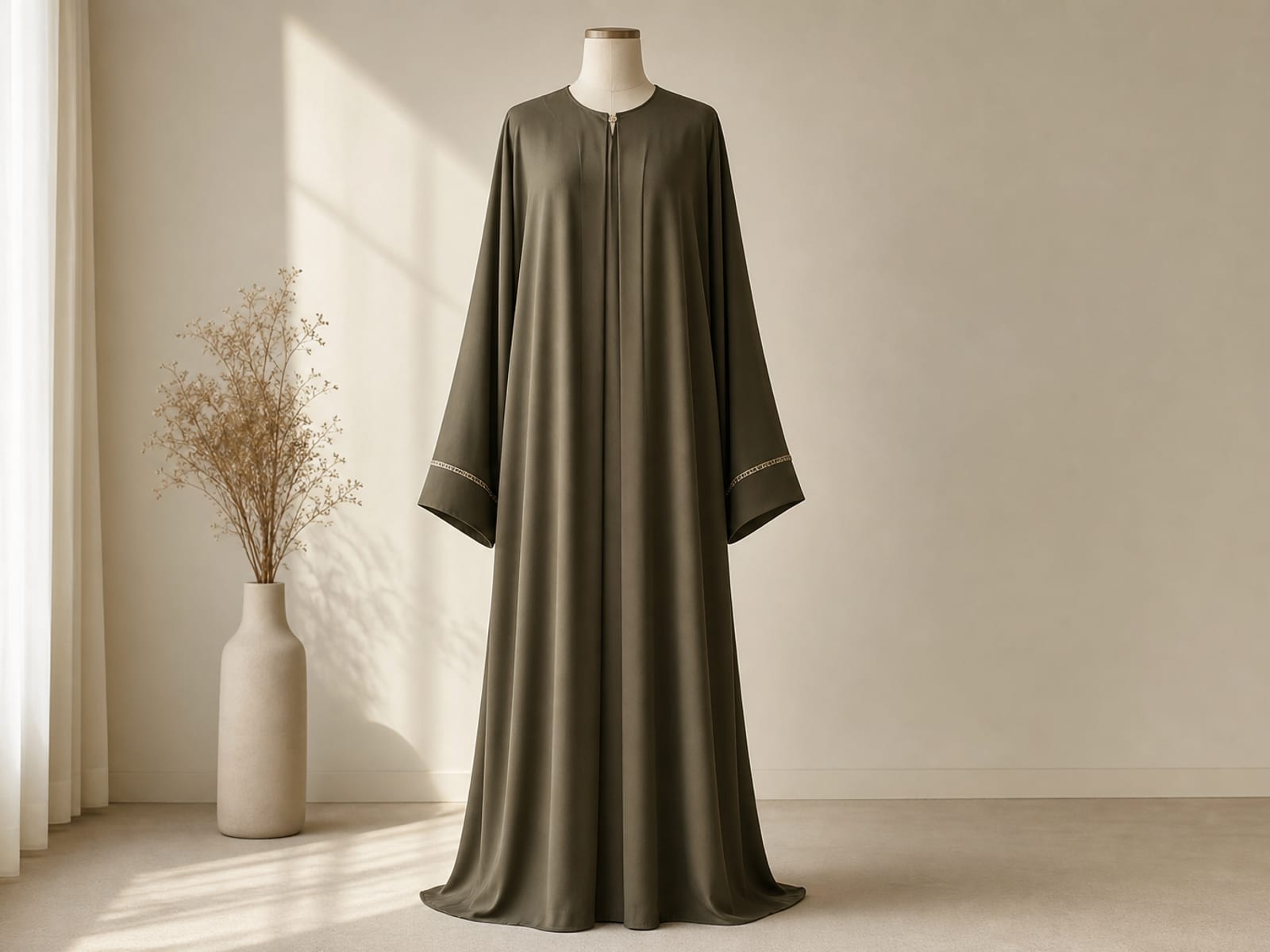
Sizing a dress is genuinely harder than sizing an abaya
Approve the measurement chart, not just the look. A dress that photographs correctly and measures incorrectly will be returned.
An abaya is largely a length decision. A dress is a bust, shoulder, waist, hip and length decision, and the customer will notice a centimetre of error at the chest long before she notices it at the hem.
So before you order a dress range, decide how many sizes you will carry and how you will measure them. If you already sell dresses, send your size chart and we work to it. If you do not, we develop the grade with you and you approve the measurement specification on the sample.
- Measurement points agreed in writing, measured on the finished garment
- Grade rule between sizes, decided once and applied consistently
- Ease allowance for a modest fit, so the dress is not tight over the body
- Length options, since the same dress is worn by different heights
- Sleeve and neckline specification, which affects coverage
Fabric for dresses: hot climate versus occasion
A dress uses more fabric than a hijab and more visible surface than an abaya, so the fabric choice shows. Crepe gives structure and hides creasing; viscose and linen blends drape softly and suit hot weather; satin and heavier wovens belong in occasion ranges.
Opacity matters more here than on an abaya, because a dress is worn as a complete garment. Check coverage at the shoulders, the back and under the arm on a real sample, and read the fabric library for how each material behaves before you commit.
- Crepe — structure and a clean line, good for formal and everyday styles
- Viscose and blends — soft drape for hot-climate everyday wear
- Linen blend — texture and breathability for summer ranges
- Satin — occasion and premium tiers
- Nida-style fabrics — used where a dress follows abaya construction
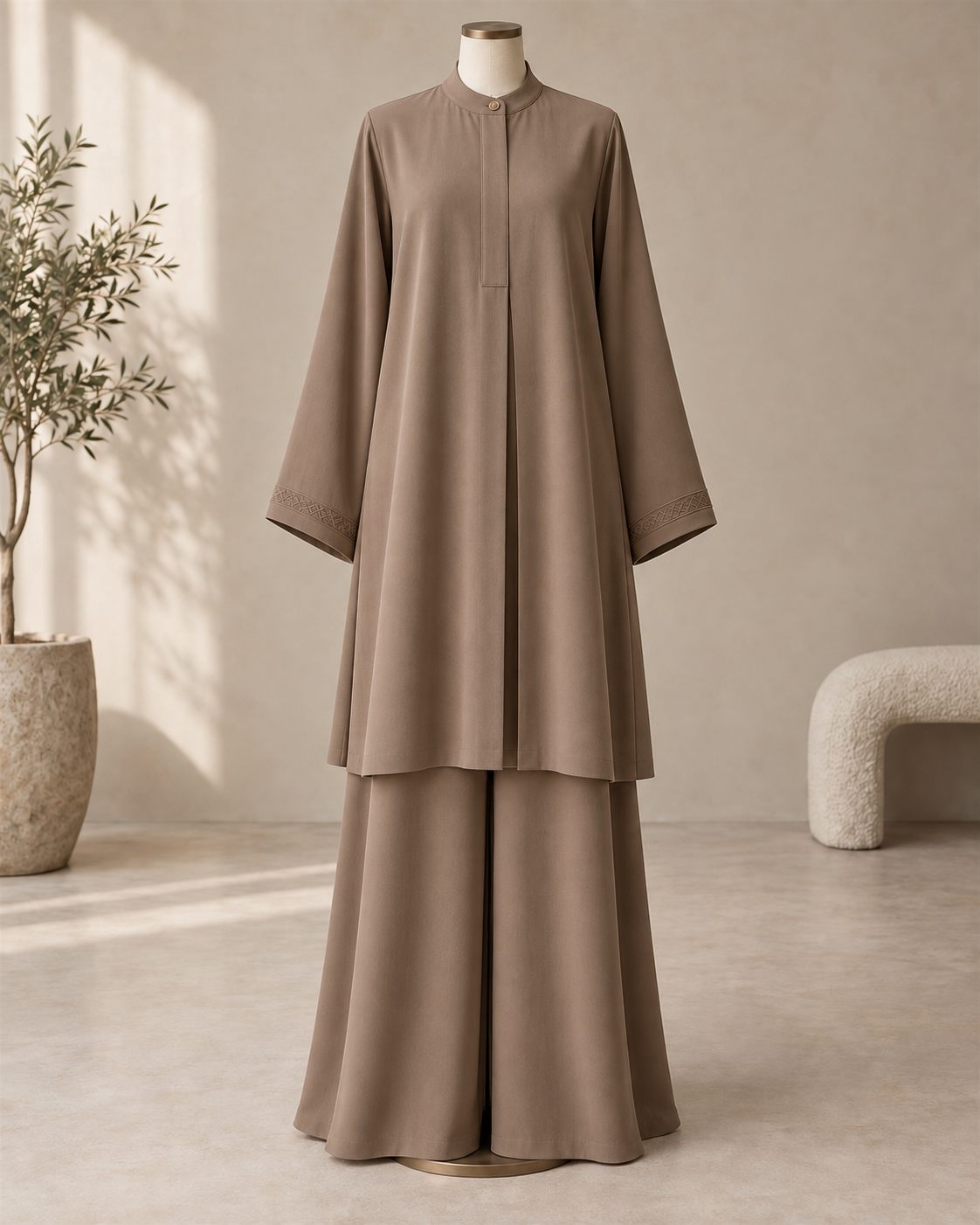
Decoration and print on a dress
Decoration raises the price tier faster on a dress than on any other modest category, because the garment is large and the decorated area is more visible. It also raises the risk of sample-to-bulk variation, since placement must hold across the whole size range.
Print is the cheaper route to differentiation. A printed dress can carry a whole collection's story, and it costs less to refresh each season than an embroidered one.
- Placement embroidery — neckline, sleeve and hem are the common locations
- All-over print — the most efficient way to refresh a dress range
- Border and hem prints — layout must follow the finished garment length
- Beading and rhinestone — highest decoration cost, best on occasion styles
- Placement control across sizes — a motif measured from the seam, not the hem
Dress or set? How the customer actually buys
A dress sells to a customer who wants one decision. A set sells to a customer who wants a look. Both work, and they work differently in the same shop.
Dresses suit fast browsing and gifting. Sets raise the average order value, because the customer leaves with two garments that were designed to be worn together. Many boutiques carry both and use the matching modest set to lift the basket.
- Single dress — one decision for the customer, simple to stock
- Dress with matching hijab — a complete outfit in one purchase
- Two-piece and three-piece sets — higher value, stronger photography
- Occasion dress with co-ord — gifting and event retail
What to specify when enquiring about dresses
Dress quotes are sensitive to fabric, silhouette and grading. These points let us price the garment you actually intend to sell.
- Silhouette and reference, with the details that matter marked
- Fabric preference or the handle you are looking for
- Size range and measurement specification
- Length options and sleeve specification
- Decoration or print, with artwork if applicable
- Lining decision, where coverage or structure requires it
- Packaging and labelling level
Quality checks for a dress order
Dress quality problems show up on the body. They are therefore checked on a fitting, not only on a table: the garment has to be tried on, moved in and inspected where it pulls.
- Measurement across sizes — the whole size run checked, not just the middle
- Fit on the body — movement at the shoulder, bust and armhole
- Coverage in daylight — shoulders, back and underarm checked on a person
- Seam and hem finishing inside — visible on unlined garments
- Decoration placement — checked on the smallest and largest sizes
- Colour and shade consistency across the size run
Where the dress category fits in your assortment
Dresses belong in the middle of a modest range: safer than custom development, more profitable than a hijab, and a natural companion to abayas. They are the category that turns a scarf shop into a clothing shop.
Plan them alongside modest clothing wholesale if you are building a full range, and consider custom modest clothing once you know which silhouette your customers actually buy.
Frequently asked questions
It depends on your customers and how deep you can stock each size. A smaller, well-chosen run in a forgiving silhouette usually performs better than a wide run in a shaped one. Decide the size range before the pattern is graded, because changing it later resets the development.
Yes, and it is the fastest route to fewer returns. Send your chart with the measurement points defined, and we grade to it and confirm the measurements on the sample before bulk. If you do not have a chart, we develop one with you and you approve it.
They can be, if the fabric and the cut are chosen for heat: a lighter, breathable fabric in a loose silhouette. A lined occasion dress in a heavy fabric will be uncomfortable regardless of how it looks. Tell us the market and the season and we will match the fabric to it.
Contact us for current MOQ. Dress orders depend on the silhouette, the fabric, the size range, whether the style is lined or decorated, and the packing level. A graded size range means more variants than a hijab order of the same total quantity.
Yes. Colour matching across a woven dress and a hijab is one of the most requested combinations, and it should be agreed at sample stage using physical swatches of both fabrics, since the same shade can read differently on each.
No. Price depends on the silhouette, fabric, lining, decoration, size range and packing, so it is quoted per order. Send the specification and the destination and you will receive a price for your order.
Planning your next modest fashion collection?
Tell us these seven things and we can come back with a workable sourcing plan instead of a price list.